
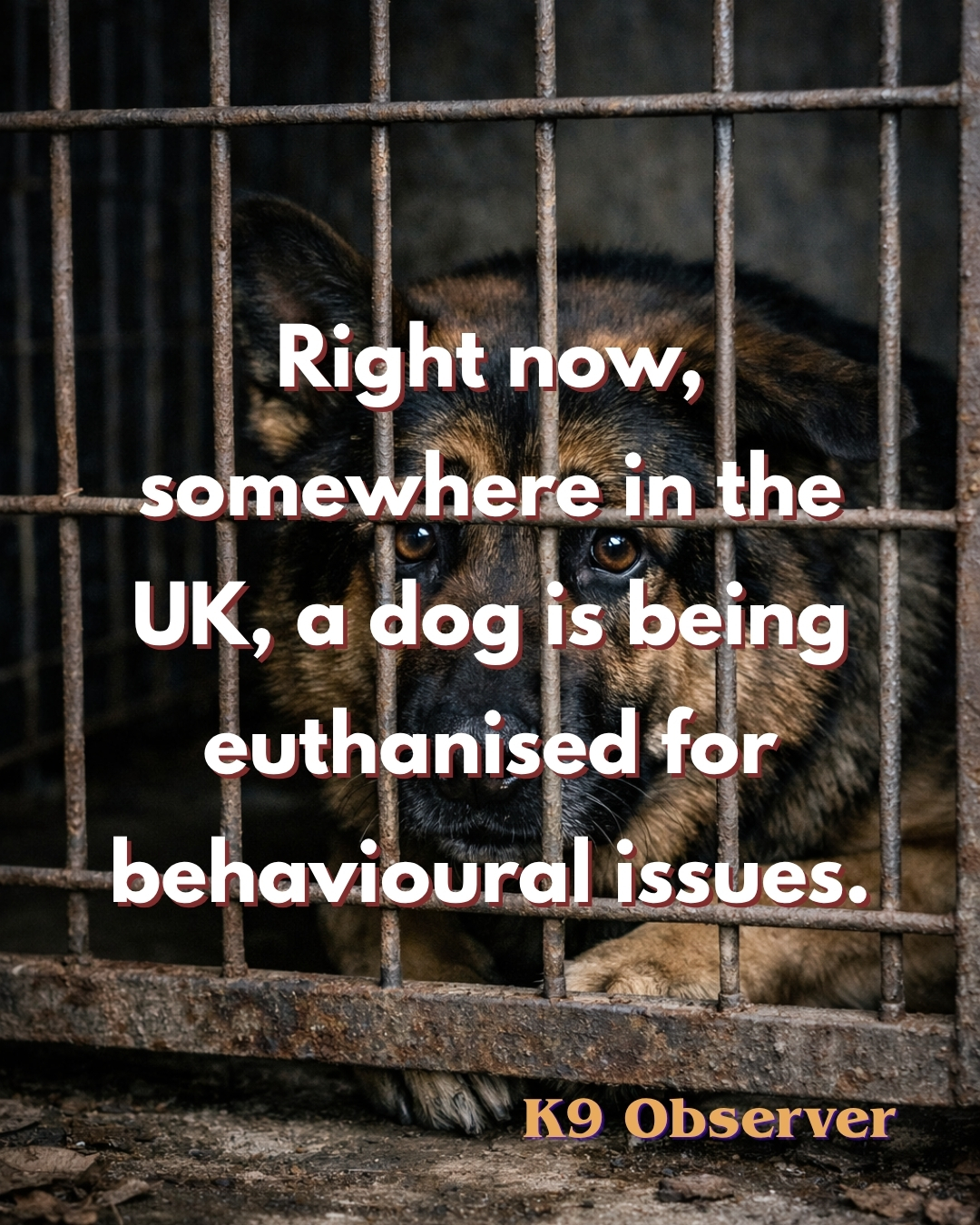
Right now, somewhere in the UK, a dog is being euthanised—not because of illness, not because of age, but because of behaviour. It’s a sentence that should stop every dog owner, trainer, and welfare professional in their tracks. Behaviour‑related euthanasia is one of the most preventable causes of canine death, yet it continues quietly, daily, and largely unreported.
The UK has no centralised system for tracking why dogs are euthanised. No national database. No mandatory reporting. No unified rescue records. Most behaviour‑related euthanasia happens behind closed doors in veterinary practices, where overwhelmed owners make heart breaking decisions with limited support and even fewer alternatives. But when we combine the UK’s largest mortality dataset with international research, a stark picture emerges: an estimated 2–7 dogs every single day are euthanised in the UK due to behaviour.
These aren’t “bad dogs.” They are dogs whose needs weren’t understood, whose early warning signs were missed, whose behaviour escalated beyond what their families could cope with. Many are young. Many are healthy. Many could have been saved with timely, skilled intervention.
A behavioural issue rarely begins with aggression. It begins with confusion: a puppy who growls over a chew; a rescue dog who panics when left alone; a young adolescent who starts lunging on lead. These are normal canine behaviours, they are signals, not sins. But without guidance, they can snowball into a crises. And when owners are told “just use treats” or “never say no,” they’re left without the tools to address the problem. By the time they seek help, the behaviour may be dangerous, rehearsed, and deeply ingrained.
This is where the dog training industry fails both dogs and owners. With no regulation, no minimum standards, and no accountability, owners are left to navigate a maze of conflicting advice. Some trainers refuse to work with aggression. Some promise “force‑free” solutions that simply don’t resolve high‑risk behaviours. Others shame owners for using tools that could have prevented escalation. Meanwhile, the dog continues to struggle—and the window for rehabilitation narrows.
Balanced, ethical, evidence‑based training does save dogs lives. It recognises that dogs are individuals with different temperaments, thresholds, and learning histories. It acknowledges that safety matters. It equips owners with a full toolkit—not just rewards, but structure, boundaries, and clear communication. It doesn’t wait for a bite to happen before taking behaviour seriously.
Every behaviour case that ends in euthanasia represents a chain of missed opportunities: missed education, missed support, missed intervention. But it doesn’t have to be this way. When owners have access to balanced trainers, early guidance, and realistic strategies, the trajectory changes. Dogs who might otherwise be surrendered or euthanised can stabilise, improve, and thrive.
We cannot save every dog. But we can save far more than we currently do. And it starts with honesty: acknowledging the scale of the problem, demanding higher standards in the training industry, and empowering owners with real, practical, science‑based help. Because right now, somewhere in the UK, a dog is being euthanised for behavioural issues.
At K9 Observer plans are underway to create welfare standards so that owners can begin to understand that balanced dog training is an ethical way to get results.
Leave a Reply