
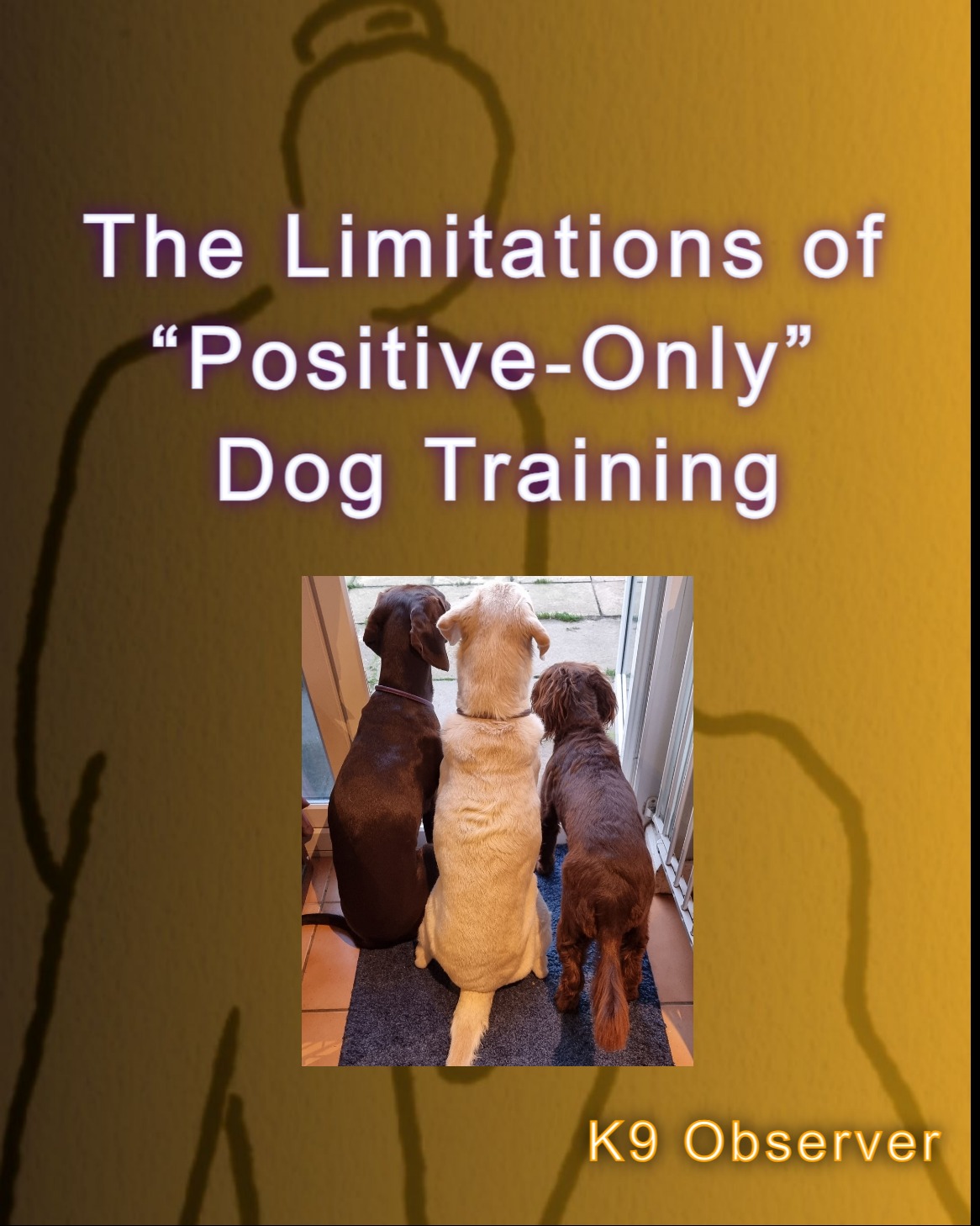
Positive reinforcement is a vital part of modern dog training — but positive‑only training (also known as force-free), where all forms of consequence, pressure, or boundary‑setting are removed, leaves dogs and owners without the full picture they need to succeed. At K9 Observer, we champion balanced, ethical, welfare‑led training because it reflects how dogs actually learn, communicate, and thrive in the real world.
This article explains why positive‑only training falls short, especially for today’s pet dogs who live in busy, high‑stimulus environments and often struggle with reactivity, impulse control, or over‑arousal.
Why Positive‑Only Training Sounds Good — But Fails in Practice
- It can’t reliably stop self‑rewarding behaviours
Many unwanted behaviours reward the dog automatically: chasing wildlife, barking at passers‑by, pulling toward dogs, jumping on guests. No amount of treats can outweigh the thrill of the chase or the excitement of greeting someone. Without the ability to interrupt or apply fair consequences, these behaviours often escalate.
- It breaks down in real‑world environments
Positive‑only protocols depend on controlled setups, distance, and low distraction. But dogs must function in:
- Busy streets
- Parks full of dogs
- Farms and livestock areas
- Homes with children, visitors, and noise
When the environment is more rewarding than the treat, the training collapses.
- It avoids boundaries — leaving dogs confused
Dogs learn through both reinforcement and consequence. Removing all forms of pressure, even mild or informational, creates:
- Poor impulse control
- Difficulty handling frustration
- Over‑arousal
- Unclear expectations
Boundaries are not punishment. They are clarity, safety, and structure.
- It often fails reactive, anxious, or high‑drive dogs
These dogs need:
- Predictable rules
- Interruptions to stop spiralling
- Calm structure
- Clear communication
“Just use treats” or “wait for calmness” does not help a dog already over threshold. Many owners are left feeling hopeless when food‑based redirection fails. It can take a dog up to 72 hours to recover from over stimulation.
- It places unrealistic demands on owners
Positive‑only systems often require owners to:
- Carry treats everywhere
- Avoid triggers indefinitely
- Manage every environment
- Ignore unwanted behaviour
Most families cannot live this way. Training should fit real life — not the other way around.
- It creates ethical blind spots
Despite claiming to be “force‑free,” some positive‑only methods rely on:
- Flooding disguised as desensitisation
- Withholding reinforcement to the point of distress
- Repetitive setups that increase frustration
Pressure still exists — it’s simply unacknowledged and uncontrolled.
- It removes half of the dog’s natural communication system
Dogs use:
- Space
- Pressure and release
- Interruptions
- Body language
- Consequence‑based feedback
Positive‑only training removes these tools, leaving the dog with an incomplete language and the owner with limited options.
The K9 Observer supports balanced, ethical, welfare‑led training because it gives dogs the full spectrum of information they need to succeed. Positive reinforcement is essential — but positive‑only is incomplete.
Dogs deserve clarity. Owners deserve methods that work in the real world. Balanced training provides both.
Leave a Reply